Empty Hands
What Alexander the Great asked for in his final hours — and what it cost me to understand it
I came across this story a few months ago.
I have been thinking about it ever since.
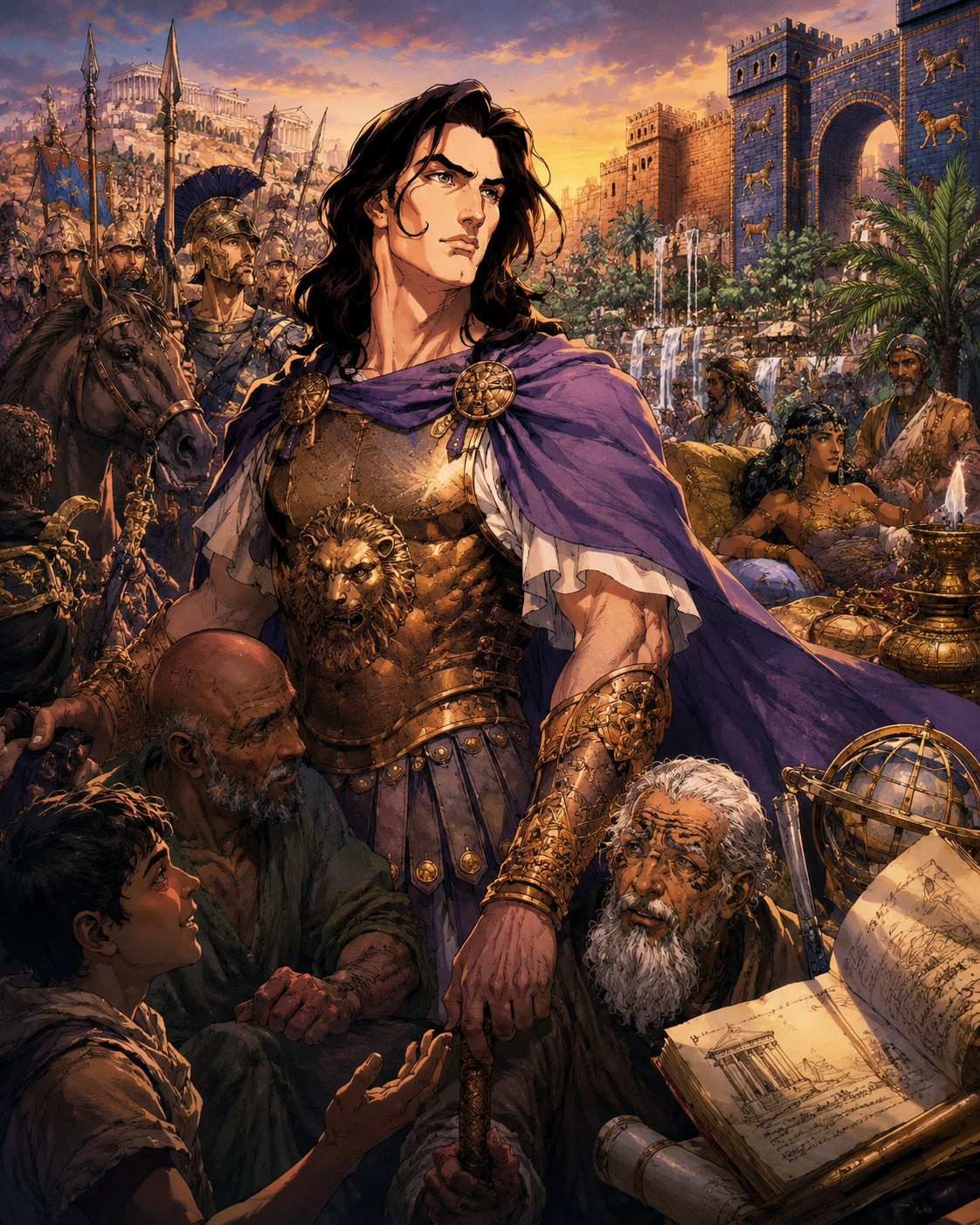
In his final hours, Alexander the Great — the man who had conquered more of the known world than anyone before or since, who had built an empire stretching from Greece to the edges of India, who had never lost a battle in his life — called his closest friends to his side and made three requests.
The first: that the best doctors in the world carry his coffin.
The second: that all the wealth he had accumulated — the gold, the silver, the jewels, the spoils of thirty years of conquest — be scattered along the road to the cemetery.
The third: that his body be wrapped in a shroud with only his hands visible, palms up, swinging in the open air.
One of his men asked why.
He replied:
I want the best doctors to carry my coffin to show that in the face of death, not even the greatest physicians in the world have the power to heal.
I want the road covered with my treasure so everyone sees that the wealth accumulated on earth stays on earth.
I want my hands swinging in the open air so people understand that we come into this world empty-handed and we leave this world empty-handed — once the most precious treasure of all is exhausted.
And that treasure is TIME.
What stopped me
I have read a lot of stories about mortality. About impermanence. About the illusion of accumulation.
This one hit differently.
Not because of the philosophy — the ideas themselves are ancient, repeated across every wisdom tradition that has ever existed. Buddhism. Stoicism. Every major religion. The understanding that we arrive with nothing and leave with nothing is not new.
What stopped me was the image.
The hands.
Palms up. Empty. Swinging in the wind.
The most powerful man who ever lived, in his final conscious moments, choosing to be remembered not by what he built or conquered or accumulated — but by what he couldn’t take with him.
He had everything. He died with nothing. And he wanted everyone watching the procession to understand that those two facts were not in contradiction. They were the same fact, seen from different angles.
What I’ve been carrying
I am forty one years old. I have lived on three continents. I have had periods of having very little and periods of building something real.
I have also spent significant portions of my life chasing the wrong things. Not consciously. Nobody chases the wrong things consciously. You chase what the world around you tells you is worth chasing — status, money, recognition, the right relationship, the right body, the right city, the right version of a life that will finally feel like enough.
And then something interrupts you. A story about a dying king and his empty hands. A night in an emergency room watching your heart rate climb to 170. A man named Phoenix who gives you a feather on a Wednesday night in Boston and disappears into the dark.
And you remember — briefly, viscerally, in your body before your mind catches up — that the only thing you actually have is time. And that how you spend it is the only question that matters.
The thing about time
We talk about time constantly. We say we don’t have enough of it. We say we need to manage it better. We buy planners and use productivity apps and optimize our mornings and read books about doing more in less of it.
But what Alexander was pointing at is not time management.
He was pointing at time meaning.
The difference between a life spent accumulating things that stay on earth when you go — and a life spent on something that mattered while you were here.
He conquered the world. He died at thirty-two. His hands were empty.
The question he left behind is not whether he wasted his life. He clearly didn’t, by any conventional measure.
The question is: what did all of it cost him?
And what does it cost us?
What I keep coming back to
I built Hero World because I finally decided to stop being a spectator of other people’s transformations and become the protagonist of my own.
That decision didn’t come from ambition. It came from the specific terror of arriving at the end of something — a relationship, a chapter, a version of myself — and realizing I had been performing a life rather than living one.
The hands swinging empty in the wind.
I don’t want that to be the last image.
Not because I’m afraid of death. But because I’m afraid of arriving there having spent the most precious thing I had — time — on things that didn’t matter to the person I actually was.
The wealth stays on earth. The doctors can’t heal what time has already taken.
What you did with the hours — that’s the only thing that goes with you.
If this resonated — share it with someone who needs to read it.
By just being here — you are already a hero.
Matteo Scaletti · #beyourownhero