The Artist Must Disappear
On mystery, creation, and why artists should never explain their work.

I have always been fascinated by the creative process.
When I encounter a great book, a painting that remains with me for days, or a performance that leaves me without words, my instinct is always the same: How did they arrive there? What happened inside that person? What invisible path led to something that now feels as if it could not have existed any other way?
Some years ago, I watched an interview with Daniel Day-Lewis, whom I consider one of the greatest actors to have ever lived. He was asked about the construction of one of his most iconic performances — I believe it was My Left Foot, the role that gave him his first Academy Award.
The interviewer wanted to understand his process. How had he built the character? How had he arrived at something so extraordinary?
His answer has never left me.
I do not remember his precise words, but the idea was something like this:
An artist should never explain completely how a work came into existence. Because in doing so, they risk destroying the very mystery that gives the work its power.
I have always found this idea profoundly beautiful.
We live inside a culture that is obsessed with explanations. We want the behind-the-scenes documentary, the director’s commentary, the making-of, the creative blueprint. We want every symbol decoded, every metaphor clarified, every hidden meaning brought into the light.
But perhaps art was never designed to function in this way.
Perhaps the mystery is not an obstacle to understanding.
Perhaps the mystery is the experience itself.
The moment an artist explains exactly what a painting means, or what a novel is truly about, or why a particular scene was written in a certain way — something subtle disappears. The work stops belonging entirely to the audience and begins to belong to the explanation.
The wires become visible.
And once you have seen the wires, it is very difficult to stop seeing them.
I have come to believe that one of the responsibilities of the artist is precisely to protect that mystery.
Not out of arrogance.
Not to appear enigmatic or distant.
But because a work of art is never completed by the artist alone.
It is the audience that finishes it.
Every reader brings their own memories. Every viewer projects onto the work their own fears, desires, losses, hopes. Two people can live inside the same story and emerge carrying entirely different truths.
Neither of them is wrong.
This is precisely what makes art something extraordinary.
A work of art is not a message waiting to be decoded.
It is a catalyst — something that ignites an experience that belongs only to the person living it.
I have felt this, on a much smaller scale, with my own writing.
People often ask me: “Did this really happen?” or “What does this piece truly mean?”
I have almost never wanted to answer.
Not because I have something to hide, but because I do not believe my interpretation is the most important one. In fact, I think it is often the least interesting of all.
Once a piece of writing leaves my hands, it no longer belongs to me.
It belongs to whoever is reading it.
Whatever they find inside those words is infinitely more valuable than anything I could explain afterward.
The work of the artist ends in the moment the work is finished.
When the film is released. When the novel is published. When the painting is finally hanging on the wall of a gallery.
At that point, the artist should quietly disappear.
The work must now live by itself.
It must survive without its creator standing beside it, continuously translating it into simpler language.
Like a parent watching a child leave the house for the first time, there arrives a moment when you must let go.
The work will be misunderstood by some.
It will be deeply loved by others.
It will come to mean things you never intended, never imagined, never even considered.
And this is not a defect.
This is its second life.
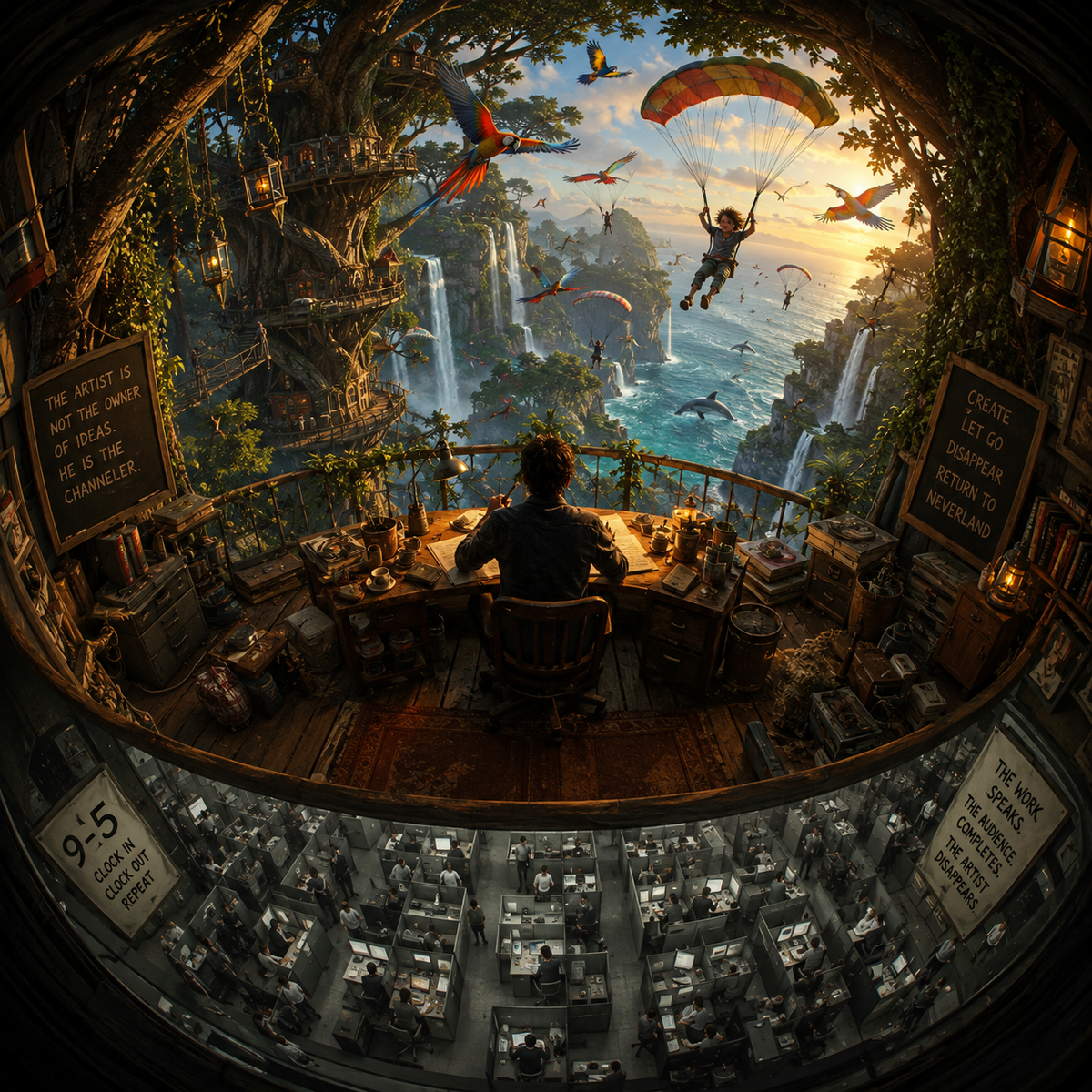
The artist is not the owner of ideas.
He is their channel.
For a brief moment, something passes through him — a story, a melody, an image, a character. He gives it shape, gives it language, gives it form.
Then he lets it go.
Once the work is finished, it no longer belongs to him.
It belongs to those who will encounter it — who will complete it with their own memories, their own fears, their own hopes, their own imagination.
And the artist?
He returns to Neverland.
To that invisible place where stories wait to be found, where dreams exist before they have been given names, where the next work is already taking shape in the silence.
PS: If this resonated — share it with one person who needs to read it
-
#beyourownhero