The Courage to Follow the Dolphin

Self discovery does not begin when you find where you belong.
It begins when you finally accept where you don't.
The Window
I remember sitting in university lecture halls in Italy, listening to professors who had been teaching the same material for thirty years, and feeling something I could not name at the time.
Not boredom exactly. Something closer to wrongness.
The kind of feeling that tells you — quietly, persistently, without drama — that you are in the wrong room.
I would look out of the window during those lectures and I would not see the courtyard or the street below. I would see other things entirely. Tropical beaches. Infinite open space. Worlds that did not exist yet in my life but felt more real than the classroom I was sitting in.
I was not daydreaming. I was receiving information.
It took me years to understand that.
And then I started living those visions. Couchsurfing in Kauai, Hawaii. Sleeping under a lighthouse in Sydney, in a region sacred to the Aboriginal people of Australia. Moving through places that most people only encounter on a screen, inhabiting them with my body, my failures, my hunger, my complete lack of a plan B.
I did not find those worlds.
I built them — first in my imagination, sitting at a desk in Italy looking out of a window, and then in reality, one continent at a time.
Two Men and One Ocean
If you have never seen Le Grand Bleu — The Big Blue — directed by Luc Besson, this article will spoil the ending. I am going to do it anyway, because the ending is the point.
The film tells the fictionalized story of two of the greatest freedivers in history: Enzo Maiorca and Jacques Mayol. One Italian, one French. Not just two different nationalities — two completely different philosophies of being.
Enzo was physical. Military. Powerful. He approached the ocean as something to conquer, a force to be defeated through strength and will and sheer masculine determination. He chased records and broke them with his body.
Jacques was something else entirely. He practiced yoga, pranayama, ancient breathing techniques. He was a solitary man who wrote books — including one called Homo Delphinus, about the deep kinship between humans and dolphins. For Jacques, the ocean was not an opponent. It was home. The only place where he felt completely himself.
Two men. The same water. Entirely different relationships with what lay beneath it.
The Last Dive
Near the end of the film, Jacques loses his friend and rival. That night, submerged in dreams of crystalline water and dolphins moving around him like light, he wakes suddenly and knows what he has to do.
His girlfriend begs him not to go. She knows, the way people who love us sometimes know before we do, that if he goes this time he will not come back. Not in the way she needs him to.
He goes anyway.
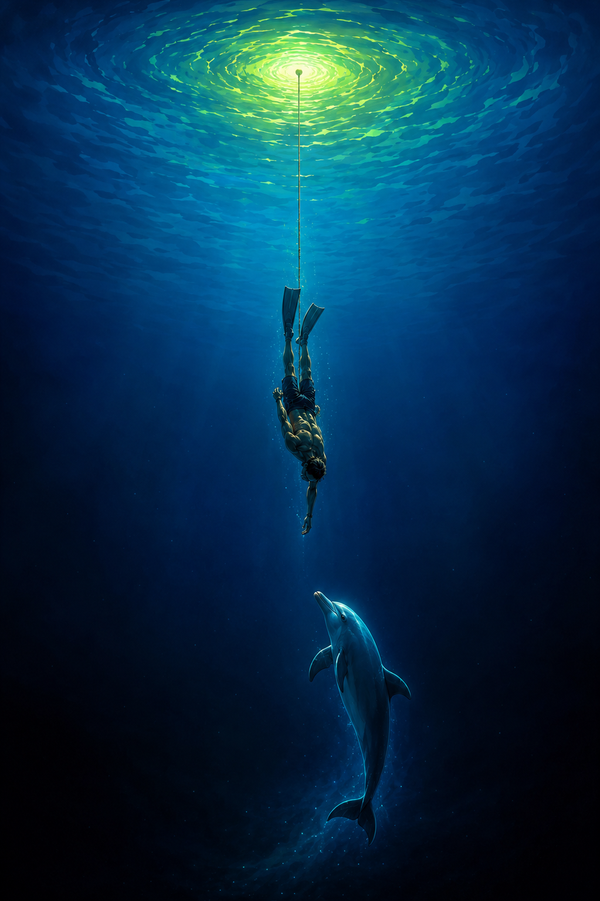
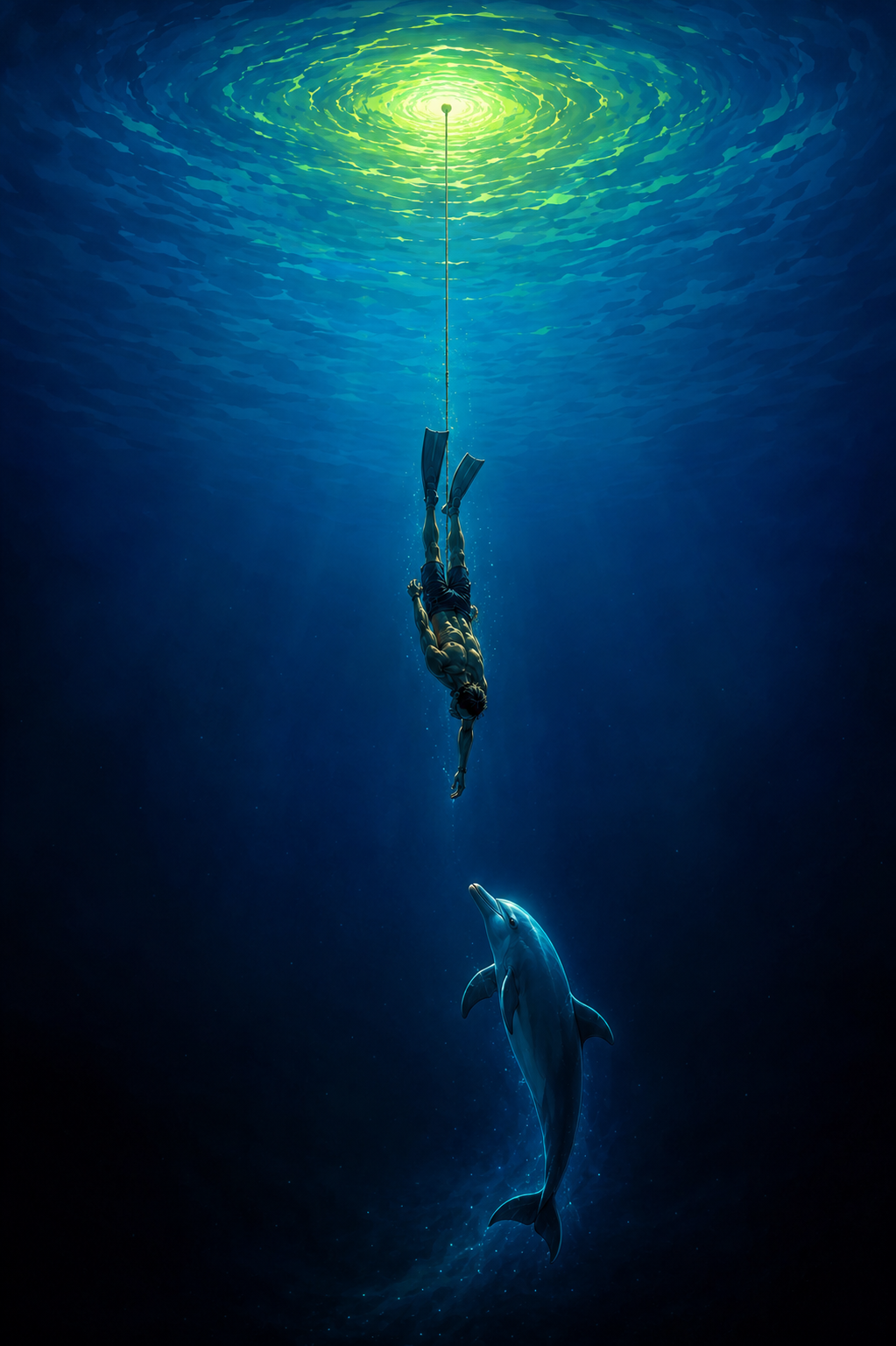
He arrives at the platform in the dark. Turns on the lights. Puts on his suit. Descends into the black water with a rope connecting him to the surface — to the world of air and land and human things.
In the depth, barely illuminated by the light above, he waits.
And then a dolphin comes.
It moves toward him slowly. Curious. Friendly. It grazes him gently and in that moment Jacques understands something he has perhaps always known.
This is his element. Down here. With them.
The surface — the land, the girlfriend, the competitions, the records, the human world with all its noise and expectation — that is not where he belongs.
He releases the rope.
And follows the dolphin into the darkness.
The Non-Belonging That Was Always a Signal
I have carried that ending with me for decades.
Not because it is tragic — though it is. But because of what it communicates about a feeling I have known my entire life.
The feeling of not quite belonging to the world everyone else seems to inhabit comfortably.
Of looking at the room you are supposed to want to be in and feeling — quietly, persistently, without drama — that it is not yours.
I used to think this was a defect. Something to be fixed or managed or explained away.
Now I understand it differently.
Non-belonging is not a wound. It is a compass.
It points away from the wrong rooms and toward the right ones — the ones you may have to build yourself, from nothing, in places nobody told you to go, through experiences that exist first only in your imagination before they exist in your life.
Jacques did not find the ocean. He recognized it. The recognition had always been there — underneath the competitions, the records, the world that wanted him to be something measurable and winning and safe.
The dolphin did not show him a new world.
It showed him the one he had always belonged to.
The Rope
Most of us spend our lives holding the rope.
The rope that connects us to the surface. To the expected path. To the version of ourselves that other people can follow and understand and approve of.
And there is nothing wrong with the rope. It is not weakness to hold it. The surface world is real and it contains real things worth holding — love, community, responsibility, belonging of a different kind.
But there are moments — not many, but the important ones — when something comes toward you in the dark. Something that recognizes you. Something that has been waiting.
And in those moments, the question is not whether to follow.
The question is whether you have the courage to release the rope.
Not forever. Not recklessly. But enough — enough to go toward the thing that was always yours.
I looked out of a university window in Italy and saw Hawaii. Saw Australia. Saw a life that did not exist yet.
And then I let go of the rope and went to find it.
It was there. It has always been there.
Waiting for anyone willing to follow the dolphin.
By just being here — with your non-belonging, your window-gazing, your hunger for worlds that don't exist yet — you are already a hero.
Download the Free Hero's Journey Field Guide:
 Hero World
#beyourownhero